Thursday, February 24, 2022

Echoes of the Past - (The Owl House Season 2 Episode 3) - 'Toon Reviews 48

 If you like this review and want to stay updated for what else I have in store, become a follower of this blog, click here to like the official Facebook page, and click here to follow me on TwitterNow on with today's review:

Echoes of the Past
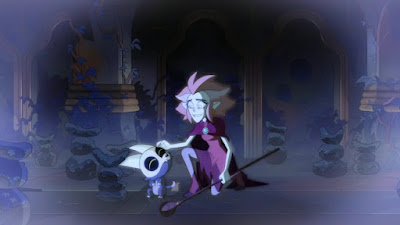
Backstories for major characters are very good hooks for subject matter.  When you spend a lot of time following someone in something like a TV series, it’s natural to want to learn where their predominant traits came from.  This here is a big selling point to this episode, and it ultimately delivers not just in what it reveals about the featured character, but also the emotions behind what’s uncovered.

Out of all the major players of the series, the one who seems to stand out the least is King.  There is some potential intrigue to constant recounts of how he used to rule over all demons, standing high and mighty among innumerable subjects.  However, it’s always been hard to take seriously given his scrawny, youthful, almost cute appearance and him sounding pretentious when bringing these claims up.  These seemingly lackluster factors to King’s background serve as an intriguing basis for what the episode ultimately brings.  Among intriguing moments like more of Lilith and Hooty’s surprisingly endearing dynamic and Luz creating a glyph for invisibility, attention is given to King’s days of grandeur.  Talk of commanding armies and having feasts isn’t much new, but then attention is given to a whole new layer to King’s background.  Apparently, his small size and childish disposition is a result of falling from a high height and a dark spell being cast upon him.  With how prominent magical forces are in this world, this new detail feels legitimate, though it makes sense that the others still don’t believe King’s claims.  In fact, according to Lilith, there’s no such thing as a king of demons as they weren’t united until the rule of Emperor Belos.  With the amount of doubt facing him, King takes initiative to prove his past valid.  From there, the episode takes a traveling approach as King leads Luz, Lilith, and even Hooty in his own portable pack to the castle where he grew up in.

Once they reach the castle, the episode really delivers on the potential for fascinating lore with the intrigue of the reveals meshing with the reactions of those who doubted King.  It’s apparently surprising enough that the castle even exists as Lilith explains that it’s not on any of her maps.  There are also very peculiar features to the location as well like a symbol at the entrance made of an unknown material and lines of rock stacks arranged like an army.  King appears to recognize all of this as familiar instantly too, as his talk of his high and regal past would lead one to expect.  Then comes the most telling point of his claims being legitimate of all.  Another part of the castle features an ancient carving of a figure who looks just like King, except bigger.  It’s so telling that Lilith and Hooty actually start believing that King truly is the king of demons after all.  It even gets to the point where they address him as a liege and ruler, demonstrating seriousness to their findings.  Clearly, this is King living the life he’s longed for or always remembered having, but what’s revealed later on turns these interesting finds into something emotional.

During her own explore of the castle, Luz uncovers a chamber full of strange creatures of inexplicable origins with crescent heads and shapeshifting veins.  One of them comes alive and proceeds to attack the visitors to the castle, seeing them as intruders.  The fact that this creature doesn’t even have a name or speak adds a huge air of mystery to the sudden encounter.  That said, it and many elements start developing somewhat of a legit background when Eda suddenly appears to save everyone from the ambush.  She had found out that King was taking the others to his castle, and from her expression of worry and shock, that was the biggest sign that the castle had something ulterior to it.  As the mysterious creature can’t attack them outside the castle, everyone has a chance to uncover that truth.  It starts when Luz suggests that the reason they were attacked is because the creature was protecting the castle from intruders.  This is the first thing to get King upset because this one simple remark reveals that Luz didn’t actually believe his constant claims of being a ruler like he thought she did.  There’s always been enough clues for this from Luz’s constant coddling of King since the beginning to King’s less than grand stature, but the pain of betrayal is clear from his point of view.  

Then Eda answers one of the show’s biggest questions; how she first met King to begin with.  Said meeting was all a result of her looking for a hiding place from the Emperor’s Coven eight years ago.  Taking refuge in that very same castle, she came across what looked like a strange animal with an unusual skill of perfectly stacking rocks into his own army of figures.  That strange animal just happened to be King.  This backstory doesn’t only answer how these two characters met either.  There’s also consideration to King’s peculiar characteristics and where they came from.  The chip on his horn is a result of that creature shooting an arrow at him; the collar is a result of Eda treating him like a pet; and most of all, him believing he’s an actual king of demons all comes from his childhood pretending shown through his stacking that Eda just played along with.  It’s here where everything there is to King is put in a new perspective.  His talk of grandeur isn’t just pretentious anymore; it was always a background he took to heart and believed was true to his identity.  Instead, it was all a childish exaggeration that everyone indulged, and what he grew up believing.  I can only imagine this as a believable effect of not growing out of childish beliefs when you get older.  Now that the truth’s out, King suddenly loses his sense of identity and suffers a meltdown, and one that feels totally real and heavy-hitting at that.

While King learning that his entire background was a lie is very emotional for himself as well as the audience watching, there are solid ways to balance the somber with good reassurance.  It’s endearing enough that Luz is quick to comfort King by telling him that even though who he thought he was isn’t true, who he is has a lot to admire.  Sincere and uplifting as this is, there’s an even bigger and more eye-opening thing to take from what ultimately happens as Luz finds legitimacy in one point to King’s claims.  The feasts and armies are clear exaggerations of the truth, but one thing that’s hard to disprove is the claim that King fell from a high height.  As a result, everyone heads back to the castle to scale their way to the top and see if there’s any truth to King’s background after all from there.  This gets the climax off to an exciting start as it makes good use of earlier established scenes covering Luz’s new invisibility glyph and the Lilith and Hooty dynamic.  It’s a lot of great action to lead everyone up to the high shaft, but at first, it feels like everyone’s just at another dead end.  

That’s when the payoff for all the emotion and heavy feelings comes in making the whole experience satisfactory.  Technically, the truths of King’s background already obtained are sufficient, but what’s uncovered here builds up to something big to look forward to.  At the top of the castle, King ends up opening a door to a hidden chamber, the very room where he was born.  Then when reapplying the bit of his horn that was chipped off, which Eda had on her all this time, King reobtains some hidden memories.  One is of a roar he heard before hatching out of his egg and another is of that creature taking him down from the shaft to be nurtured.  The big takeaway is that the roar means that King is the son of whoever made that sound, and that creature was assigned to take care of King.  In other words, King gets a clue on the identity of his father, and he is therefore set up to see who it really was.  Like all mysteries uncovered throughout the show, including the ones solved in this very episode, there’s major intrigue to get the audience excited for what’s to come.  This particular reveal especially stands out for after so much of King being disproven, there’s a legit spot of hope for something big and reassuring.  It’s all the more fitting for such a likable cast.

One of the biggest strengths of this show is its ability to constantly have the audience rethink the meaning behind earlier moments and episodes.  That’s the biggest strength of this episode where all there is to King’s character is put into a new perspective, bringing emotional effects and huge promise for big reveals in the future. 

 A+

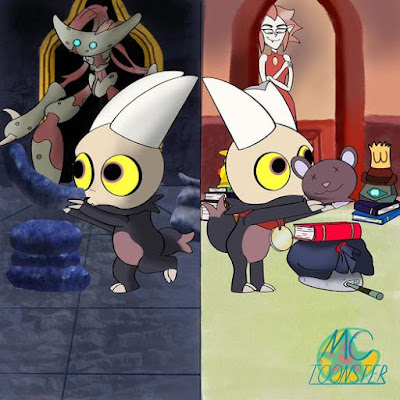
Fan Art

Series Ranking

1.      Enchanting Grom Fright

2.      Agony of a Witch

3.      Echoes of the Past

4.      Escaping Expulsion

5.      Understanding Willow

6.      Lost in Language

7.      Adventures in the Elements

8.      The Intruder

9.      Covention

10.  Young Blood Old Souls

11.  Separate Tides

12.  Escape of the Palisman

13.  Wing it Like Witches

14.  The First Day

15.  I Was a Teenage Abomination

16.  Witches Before Wizards

17.  Something Ventured, Someone Framed

18.  A Lying Witch and a Warden

19.  Sense and Insensitivity

20.  Hooty’s Moving Hassle

21.  Really Small Problems

22.  Once Upon a Swap

The next Owl House review features the first appearance of Eda and Lilith's mother who arrives with a cure for Eda's curse...or so she says.

Next time on MC Toon Reviews is "Truck Stop Polly" and "A Caravan Named Desire" from Amphibia.

If you would like to check out other Owl House reviews on this blog, click here for the guide made especially for them. 

Tuesday, February 15, 2022

The Ballad of Hopediah Plantar / Anne Hunter - (Amphibia Season 2 Episode 2) - 'Toon Reviews 49

 If you like this review and want to stay updated for what else I have in store, become a follower of this blog, click here to like the official Facebook page, and click here to follow me on TwitterNow on with today's review:


The Ballad of Hopediah Plantar


When traveling is a big part of a season, it can put every story along the way into a new perspective.  Even random adventures without much connection to the big picture feel worth exploring because it always feels like the show is getting somewhere.  That said, not every escapade is going to turn out remarkable. This part of the journey to Newtopia is decent in exploring characters, but the execution doesn’t leave the strongest payoff.  

While we’re in a new season, the memories of the end of the previous one are fresh on everyone’s mind. Sprig has even been inspired to write a ballad about that encounter, fitting his unique frequently seen talent as a bard.  As fun as his song is, it ignites a feeling of self-consciousness within Hop Pop.  One of the big takeaways from the end of Season 1 was how he had grown to become inspirational to several frog towns to rebel against authorities.  For Sprig’s song to say that all he did was hide and cower, which isn’t even that accurate, it’s no surprise Hop Pop is desperate to show he is a true hero.  

This brings the Plantars to the first town outside of Wartwood, Bittyburg, a welcome sign of world building, inhabited by very small frogs with big eyes.  In accordance with Wild West towns, Bittyburg is invaded by outlaw Jethro Hassleback, the inhabitants’ small size making them easy targets.  Wanting to do something about this injustice, Hop Pop stands in to help the town, and beats Jethro easily.  However, the praise he gets from the Bittyburg citizens cause him to forget the heart of his actions, and he presents himself a hero for bravado purposes.  As he recounts his past escapades, he exaggerates the details by making himself seem stronger than he really was, especially at Toad Tower.  It seems harmless at first almost like “marketing”, but then Jethro comes back with the entire Hassleback family.  The whole gang easily beats Hop Pop, and he’s forced to admit he’s not actually a hero. 

It’s here when the cartoon feels overly self-deprecating that doesn’t help the story’s execution.  It feels like Hop Pop is incapable of making a difference despite proving to do so in the past, including here.  The best part of it though is a strong instance of heart.  In an interesting move, it’s Anne who’s the voice of reason as she tells Hop Pop that true heroism is from doing what’s right for others, not the songs and glory you get from it.  

Out of this legitimately good advice, Hop Pop is inspired to go back and help Bittyburg however he can.  He’s got the Wild Western getup and is all set to take on the Hasslebacks with the showdown inevitable.  It even feels like he’s strong enough to face them with the punches thrown at them.  Then it turns out that all of Hop Pop’s strong moves were from the kids firing ammo from the distance.  Dishonest as it is, this is still effective in beating the bad guys, and that’s why it stings when the Hasslebacks catch them and belittle Hop Pop again.  Then right on cue, the citizens of Bittyburg snap and go from cute to monstrous as they finally beat the Hasslebacks.  While there is logic to this happening now with years of abuse having built up enough to make them snap, it still feels way too convenient.  Plus, when they say they stepped in because Hop Pop can’t help himself, it ends the cartoon by suggesting that he’s totally hopeless, which again feels overly harsh.  

There’s merit behind starting to explore more of Amphibia and good character based endearment in parts, but because of the overall payoff, this cartoon isn’t too big of a heroic feat.

B-

Anne Hunter

Animated works are strong enough when they leave their own unique interpretations on life, but they stand out more when their events have some basis in fact.  This in turn helps get the audience invested for the entire runtime.  For that, it helps that the premise for this cartoon is of believable challenges faced when travelling, and heart between characters.  

The Plantars haven’t gotten far beyond Wartwood at this point in the trip, but they’re already strapped for food.  This in turn gives good weight to this animated frog family’s travels by giving them a challenge that can happen at any time during a trip.  Anne, sympathetic to the situation, offers to counteract the food shortage by hunting.  This is certainly a good show of loyalty on her part, and is enhanced by her idea of what hunting is like through imagine spots of her as a big hero great with weapons.  

However, when actually hunting, Anne is surprisingly accompanied by young Sprig who actually has a believable hunting method, no weapons required.  It covers basic ways to live off the land by tracking prey, building a trap, and especially luring them into the trap with an erratic dance.  This strategy is apparently the perfect way to catch resident creatures, grubbles, whose appearance bring to mind something like cream puffs.  As impressive as it is that Sprig is so knowledgeable on hunting and his strategy is very effective, Anne does not get the appeal of her friend’s teachings.  She insists on sticking to weapons alone and expresses embarrassment over the likes of Sprig’s dance, even though it  worked.  She’s clearly stubborn, but this strong disdain doesn’t last long.  

Shortly after the hunting demonstration, the Plantars are suddenly taken by a scorpileo, a giant combination of a lion and a scorpion, leaving Anne alone to save them.  At first, she’s insistent on just rushing after them with a stick to beat it, but then she quickly discovers fault in her strategy by seeing just how difficult it is to track it.  The cartoon’s direction is clearly leaning towards supporting Sprig’s method, the more realistic hunting strategy, but creative staging is still principle.  When the situation seems hopeless, Anne is visited by a hallucination of Sprig’s head.  There’s solid comedy in her awareness to him being a stress-induced mind figure, and the hallucination of Sprig coming off as a very dynamic character and guide. Also, with all of the guidance implied to be coming from Anne’s mind, there’s implication that Sprig’s nature-based style of hunting did actually stick with her.  Through extreme natural methods of smelling the air and tasting dirt, Anne is successful in tracking the scorpileo who took the Plantars.  

Then there’s the matter of actually catching it.  After building the pit comes the process of luring it in, and to do that, Anne must perform the dance she looked down upon hardly earlier.  The animation medium especially shines here as the sounds of nature from small animal noises to falling rain give Anne the rhythm needed to perform the dance.  Strange as the actual dance is, it’s got a nice flowing movement and expert timing for Anne to effortlessly attract the scopileo, and dodge it as it falls into the pit.  The Plantars are saved, Anne has a better understanding of nature, and everyone has a good laugh over her talking to a hallucination.  This cartoon is overall a random escapade, but for fitting the travel theme well, strengthening good family bonds, and memorable sequences, it’s a great part of the trip.

Also as a way of helping to further things alone, the end of this cartoon and its companion give attention to that robot following the Plantars.  It’s a good way of giving the audience something big to think about and gives purpose to the randomness.  If only this robot is followed up on in more than just a select few cartoons.

A

Series Ranking

1.      Reunion

2.      Toad Tax

3.      Anne vs Wild

4.      The Domino Effect

5.      Prison Break

6.      Anne of the Year

7.      Contagi-Anne

8.      Best Fronds

9.      Family Shrub

10.  Hop-Popular

11.  Anne Hunter

12.  Wally and Anne

13.  Children of the Spore

14.  A Night at the Inn

15.  Handy Anne

16.  Lily Pad Thai

17.  Dating Season

18.  Anne or Beast?

19.  Combat Camp

20.  Cursed!

21.  Snow Day

22.  Civil Wart

23.  Stakeout

24.  Croak and Punishment

25.  Taking Charge

26.  Flood, Sweat, and Tears

27.  Bizarre Bazaar

28.  Trip to the Archives

29.  Anne Theft Auto

30.  Hop Luck

31.  Hop Pop and Lock

32.  Plantar’s Last Stand

33.  Fort in the Road

34.  The Big Bugball Game

35.  Fiddle Me This

36.  Family Fishing Trip

37.  The Ballad of Hoppediah Plantar

38.  Girl Time

39.  Breakout Star

40.  Grubhog Day

41.  Cane Crazy

42.  Sprig vs Hop Pop

43.  Cracking Mrs. Croaker


The next Amphibia has Polly resort to the life of a trucker when feeling under-appreciated, and Hop Pop gets a chance to make it as an actor.
Next time on MC Toon Reviews is "Echoes of the Past" from The Owl House.
If you would like to check out other Amphibia reviews on this blog, click here for the guide made especially for them.